

Most ethical discussions are conducted at the surface level. They focus on the “Decision Point”—the moment where an individual chooses between Option A and Option B. We debate the merits of specific actions, the nuances of consequences, and the adherence to explicit rules. This is “Top-Down” ethics. It assumes that morality is a conscious choice made by a rational actor in real-time. However, for the high-agency operator, this model is dangerously incomplete. It ignores the Invisible Infrastructure that governs behavior before a conscious thought is ever formed.
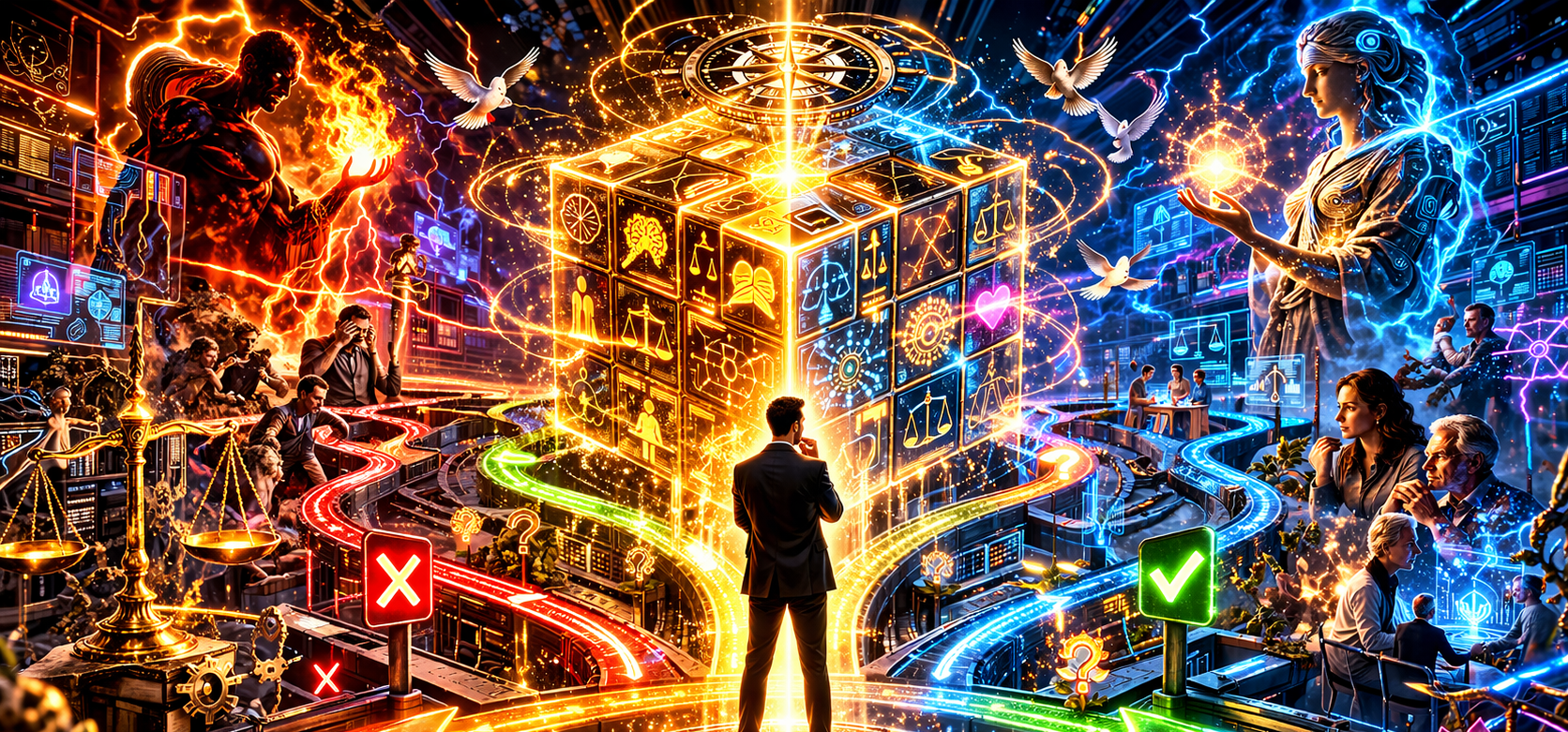
The Deep-State Moral is the recognition that your ethics are not a list of rules you follow; they are the Architecture of your Subconscious. They are the load-bearing pillars, the reinforced conduits, and the foundational bedrock of your psyche. To achieve true sovereignty, you must move beyond surface-level “Rule-Following” and immerse yourself in your own ethical architecture. You must ensure that your “Deep State”—the ingrained habits, the reflexive responses, and the subterranean values—is perfectly aligned with your sovereign mission. When your architecture is sound, integrity is no longer a struggle of will; it is an Engineered Inevitability.
The Surface vs. The Substructure
Traditional morality treats the mind like a courtroom where arguments are heard and a judge (the conscious self) renders a verdict. This is an inefficient and energy-intensive way to live.
- The Surface Level (The Courtroom): This is where you deliberate. It is prone to “Analysis Paralysis,” emotional fatigue, and the “Willpower Drain.” If you have to “choose” to be ethical every time, you will eventually fail when your cognitive energy is depleted.
- The Deep-State Level (The Architecture): This is where you Are. It is the collection of “hard-coded” heuristics that drive your behavior when you are tired, panicked, or under extreme pressure. It is the operating system that runs in the background.
The sovereign goal is to move as much ethical processing as possible from the Surface to the Substructure. You don’t want to “decide” to be honest; you want to be a person for whom lying is a Structural Impossibility.
Protocol I: The Subterranean Audit (Mapping the Blueprint)
You cannot refactor a system you do not understand. The first step of immersion is to map your existing ethical architecture. You must descend into your own “Deep State” and identify the pillars that are currently holding up your world-view.
- The Reflex Test: Analyze your automatic responses to low-stakes stressors. When someone makes a mistake, is your first reflex to find a solution or to assign blame? When you find a minor error in your favor, do you keep quiet or correct it? These reflexes are the “Exposed Rebars” of your deep-state architecture.
- The Shadow Search: Identify the values you possess that you have never consciously chosen. These are often “Ghost Structures”—inherited from parents, culture, or early trauma. Do you have a subterranean “Need for Approval” or a “Fear of Scarcity” that is subtly tilting your ethical scales?
- The Load-Bearing Analysis: Determine which values are truly “Load-Bearing.” If you lost your wealth, your title, and your social standing tomorrow, which parts of your character would remain standing? The parts that remain are your Primary Architecture. Everything else is just decorative.
Protocol II: Structural Refactoring (Rewriting the Code)
Once the blueprint is mapped, the sovereign operator begins the process of Subterranean Refactoring. You are not “learning” new values; you are “installing” them into the foundation so that they become automatic.
- Heuristic Hardening: Replace complex moral debates with “Indisputable Heuristics.” Instead of debating the “Ethics of Transparency” in every meeting, you install the heuristic: “If the data is true, it is disclosed.” By making the rule absolute and subterranean, you bypass the cognitive cost of deliberation.
- The Identity Merge: You stop saying “I should do X” and start saying “I am the type of person who does X.” This is the transition from “Behavioral Modification” to “Identity Engineering.” When a value is integrated into your identity, violating it feels like a violation of your own physics.
- Environment Priming: Your Deep State is constantly influenced by your environment. To maintain a sovereign architecture, you must “Prime” your surroundings with signals that reinforce your code. Surround yourself with high-agency peers, high-resolution information, and physical spaces that broadcast the standard you have set for yourself.
Protocol III: The Integrity Stress-Test (Verifying the Build)
An architecture is only as good as its performance under load. To verify that your deep-state morals are functioning, you must subject them to Calculated Pressure.
- The Temptation Simulation: Mentally place yourself in a scenario where a massive gain is available through a minor breach of your code—with zero chance of being caught. If your internal response is “How can I justify this?” your architecture is still on the surface. If your response is an immediate, visceral “No,” the code has reached the deep state.
- The Fatigue Audit: Monitor your behavior during periods of extreme metabolic or cognitive exhaustion. When the “Conscious Judge” is asleep, does the “Architecture” still hold the line? If you become a different, less ethical person when you are tired, your deep-state moral is not yet installed.
- The Crisis Pivot: Analyze your performance during a genuine crisis. In the moments when you had no time to think, did you act with integrity? A crisis is the ultimate “Architectural Survey.” It reveals exactly where the structure is solid and where it is hollow.
Protocol IV: The Integrated Operating System
The final end-state of the Deep-State Moral is Total Integration. This is where the gap between your “Mission” and your “Motion” disappears. You achieve a state of “Ethical Flow.”
- Zero Friction: Because your ethics are structural, they no longer require willpower. You exert no effort to be “good” or “principled.” You are simply functioning according to your own design.
- Decisional Supremacy: Your speed of execution increases exponentially. While others are bogged down in the “Ethics Committee” of their own minds, you are moving. Your deep-state code provides instant answers to complex problems.
- Structural Aura: A person with an integrated, deep-state moral architecture broadcasts a different kind of “Signal.” It is the aura of unshakeable certainty. This signal acts as a filter, attracting other sovereign operators and repelling those who seek to exploit the “Cracks” in a surface-level morality.
Conclusion: Building for the Long Game
Surface ethics are for the “Settlers”—those who want to look good in the eyes of the crowd. Deep-state ethics are for the Operators—those who want to BE sovereign in a world of chaos.
The goal of your philosophical journey is not to collect more rules, but to build a more formidable self. You are the architect, the contractor, and the building. Do not settle for a surface-level coat of moral paint. Descend into the depths. Dig out the rotted foundations. Pour the concrete of first-principles integrity. When you have engineered your Deep State to match your highest mission, you don’t just “survive” the market; you stand through it, unshakeable and absolute.
Map the depths. Refactor the code. Stand the structure.










Leave a Reply