

The default state of the human mind is a Read-Only moral environment. From the moment of birth, you are bombarded with a continuous stream of legacy code—cultural norms, parental warnings, religious dogmas, and educational biases—that you are expected to execute without question. This is not a functioning philosophy; it is a collection of “patches” designed to ensure your compliance with the collective. For the average person, “Conscience” is simply the sound of these competing programs clashing in the background. To operate at a sovereign level, you must perform a radical system reset. You must move from executing an inherited script to Initializing your own Moral Operating System (mOS).
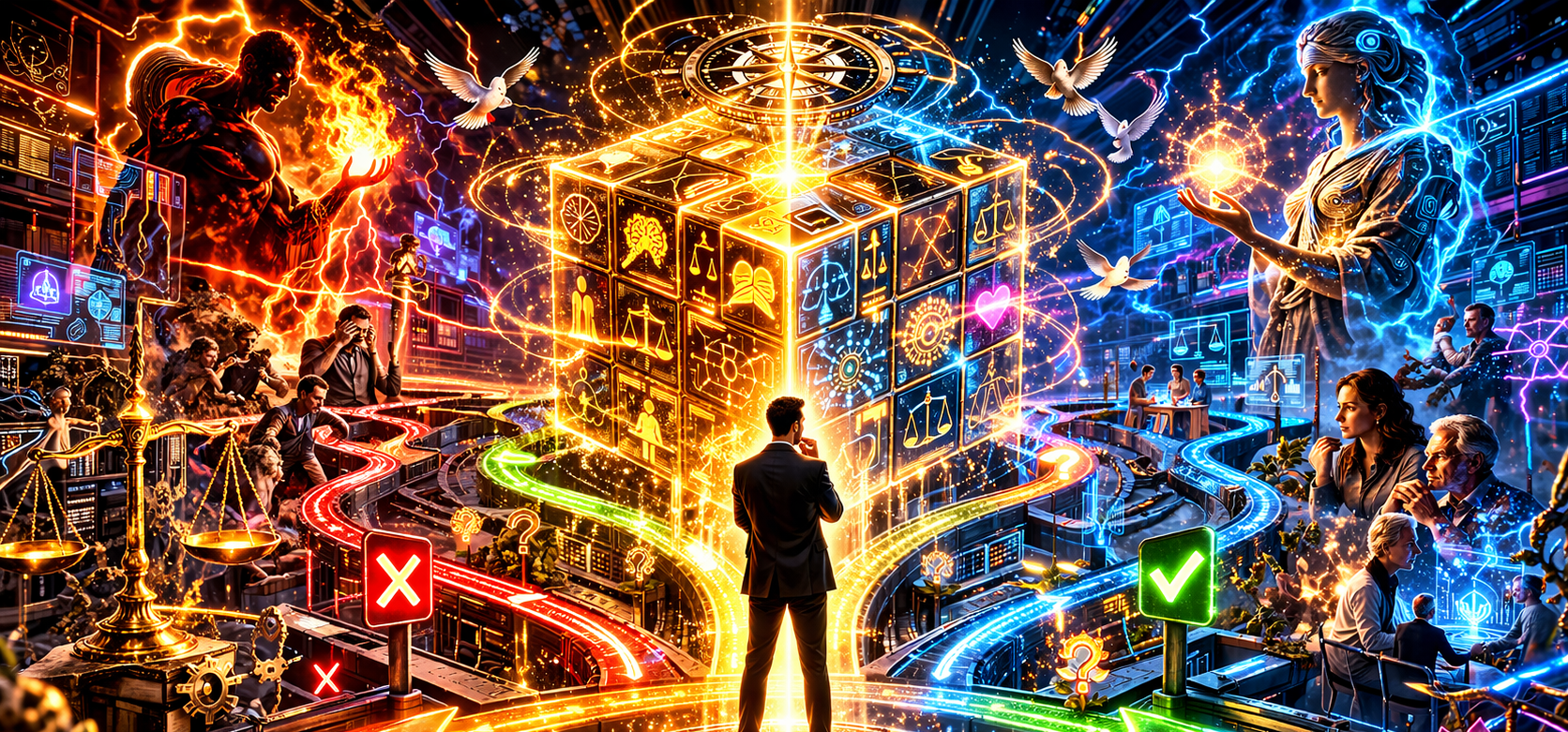
The Entry Node is the point of transition. It is the moment you cease to be a passive recipient of external values and become the primary developer of your own internal logic. Initializing a moral OS is not about “finding your truth”—a phrase that implies the truth is already there, buried under layers of social conditioning. It is about Engineering a Reality. It is the technical process of establishing the core kernel, the security protocols, and the driver interfaces that will govern your every interaction with the world. Without an initialized OS, you are not an operator; you are an asset being managed by the environment.
The Legacy System: Why Your Current Hardware is Failing
Before initialization can occur, you must acknowledge the catastrophic state of your legacy system. Most professionals attempt to build a “Sovereign Career” on top of a Fragmented Moral Substructure. This results in a state of high-friction existence characterized by:
- Inconsistency of Execution: Because your values are a patchwork of different sources, they often contradict each other. You value “Transparency” until it becomes uncomfortable, or “Loyalty” until a better offer appears. This variance is a bug in the code.
- External Signal Vulnerability: Without a proprietary OS, your “Moral State” is dictated by the current social consensus. You are easily manipulated by outrage cycles, virtue signaling, and the shifting goalposts of institutional “Correctness.”
- Cognitive Bloat: Maintaining a collection of unvetted, contradictory values requires an immense amount of metabolic energy. You spend your day “wrestling” with your conscience because your system lacks a clear, unified logic for decision-making.
Initialization is the act of Wiping the Drive and installing a system that is consistent, resilient, and entirely your own.
Phase I: The Bootstrapping Process (Establishing the Kernel)
In computing, the “Kernel” is the core of the operating system—the bridge between the hardware (your biology) and the software (your actions). In a moral OS, the kernel consists of your Non-Negotiable Axioms. These are the few, deep-state principles that remain fixed regardless of the external environment.
- The Sovereignty Axiom: This is the bedrock of the system. It dictates that you are the sole owner of your time, your focus, and your output. Any moral choice that requires the permanent surrender of your agency is a system-level failure and must be rejected.
- The Reciprocity Driver: This governs all external interfaces. You provide value in direct proportion to what you expect to receive. You engage in “Infinite Games” with fellow sovereigns and “Zero-Sum Defenses” against predatory systems.
- The Fidelity Protocol: This ensures the integrity of your internal data. You do not lie to yourself. You treat reality as it is, not as your ego or your fears would have it appear. High-fidelity information is the fuel of a sovereign mind.
These axioms are not “suggestions.” They are the Physical Laws of your internal universe. If a proposed action violates the kernel, the OS refuses to execute it.
Phase II: Driver Installation (Interfacing with the World)
A kernel is useless if it cannot interact with the hardware of the market. Drivers are the specialized sub-routines that allow your core axioms to translate into daily conduct. They handle the “Micro-Transactions” of life.
- The Communication Driver: This protocol manages the flow of information. It replaces “Polite Ambiguity” with “Strategic Candor.” It ensures that your “Yes” and your “No” carry the weight of absolute certainty.
- The Conflict Driver: Most legacy systems are programmed to avoid conflict. A sovereign OS installs a “Conflict Resolution Routine” that treats friction as data. It allows you to navigate disagreement without emotional volatility, focusing on the preservation of the kernel rather than the preservation of comfort.
- The Resource Driver: This manages the allocation of your capital—mental, financial, and biological. It filters every opportunity through a “Value-Exchange Matrix,” ensuring that your metabolic energy is never spent on low-impact, high-entropy tasks.
Phase III: The Security Layer (Filtering the Social Signal)
The greatest threat to a newly initialized OS is Infiltration. The world will constantly try to install “Malware”—guilt trips, social pressure, and manufactured crises—into your system. Your security layer must be impenetrable.
- The Mimetic Firewall: This identifies and blocks “Copycat Values.” It detects when you are adopting a stance simply because the crowd is doing so. It forces a “First-Principles Audit” on every new piece of moral data before it is integrated into the system.
- The Guilt Filter: Guilt is a legacy emotion used by institutions to enforce compliance. A sovereign OS replaces guilt with Systemic Responsibility. If you fail, you don’t “feel bad”; you analyze the error, patch the code, and move on. You refuse to pay the “Emotional Tax” demanded by the collective.
- The Reputation Shield: You recognize that your reputation is a “Market Signal” that you do not fully control. While you maintain high integrity to protect your brand, you do not allow the perception of others to dictate your intent. Your internal code is the only judge that matters.
Operationalization: Running the Code in Real-Time
Initialization is complete when the OS moves from a “Theoretical Sandbox” to Real-Time Execution. This is where the theory becomes kinetic.
- Decisional Velocity: An initialized OS removes the “Deliberation Gap.” Because the rules are hard-coded, you don’t “wonder” what the right move is. You run the variable through the kernel and execute the output immediately. You move while others are still reading the manual.
- Structural Integrity: Even under extreme pressure—financial loss, social isolation, or physical exhaustion—the OS holds. The axioms are load-bearing. You are the same person in the dark as you are in the light because your morality is a Hard-Wired System, not a costume.
- Systemic Growth: A sovereign OS is self-correcting. It treats every failure as a “Debug Opportunity.” You are constantly refactoring your drivers and hardening your security layer based on real-world feedback. Your morality is an evolving, high-performance engine.
Conclusion: The Mandate of the Initialized
Most people die executing a version of the software that was written by their great-grandparents and patched by a thousand strangers. They are the “End-Users” of their own lives, frustrated by glitches they don’t understand and limitations they didn’t choose.
The sovereign operator takes the Entry Node. You wipe the drive. You install the kernel. You initialize the system. From that moment forward, you are no longer a passenger in the moral landscape of the collective. You are the architect of your own character and the commander of your own fate.
The system is online. The logic is clear. Execute the mission.







Leave a Reply