

In the theater of high-stakes operations, “Decisiveness” is often heralded as the ultimate leadership trait. However, decisiveness without a underlying logical framework is merely impulsivity masquerading as strength. Most professionals, when faced with a complex ethical dilemma, fall back on Moral Intuition—a vague, internal “feeling” of what is right or wrong. While intuition can serve in low-complexity, domestic environments, it is a catastrophic failure in the “Gray Zones” of global markets, strategic negotiations, and systemic crises. Intuition is vulnerable to fatigue, emotional manipulation, and the recency bias. It is a “Soft System” that buckles under the weight of high-entropy variables.
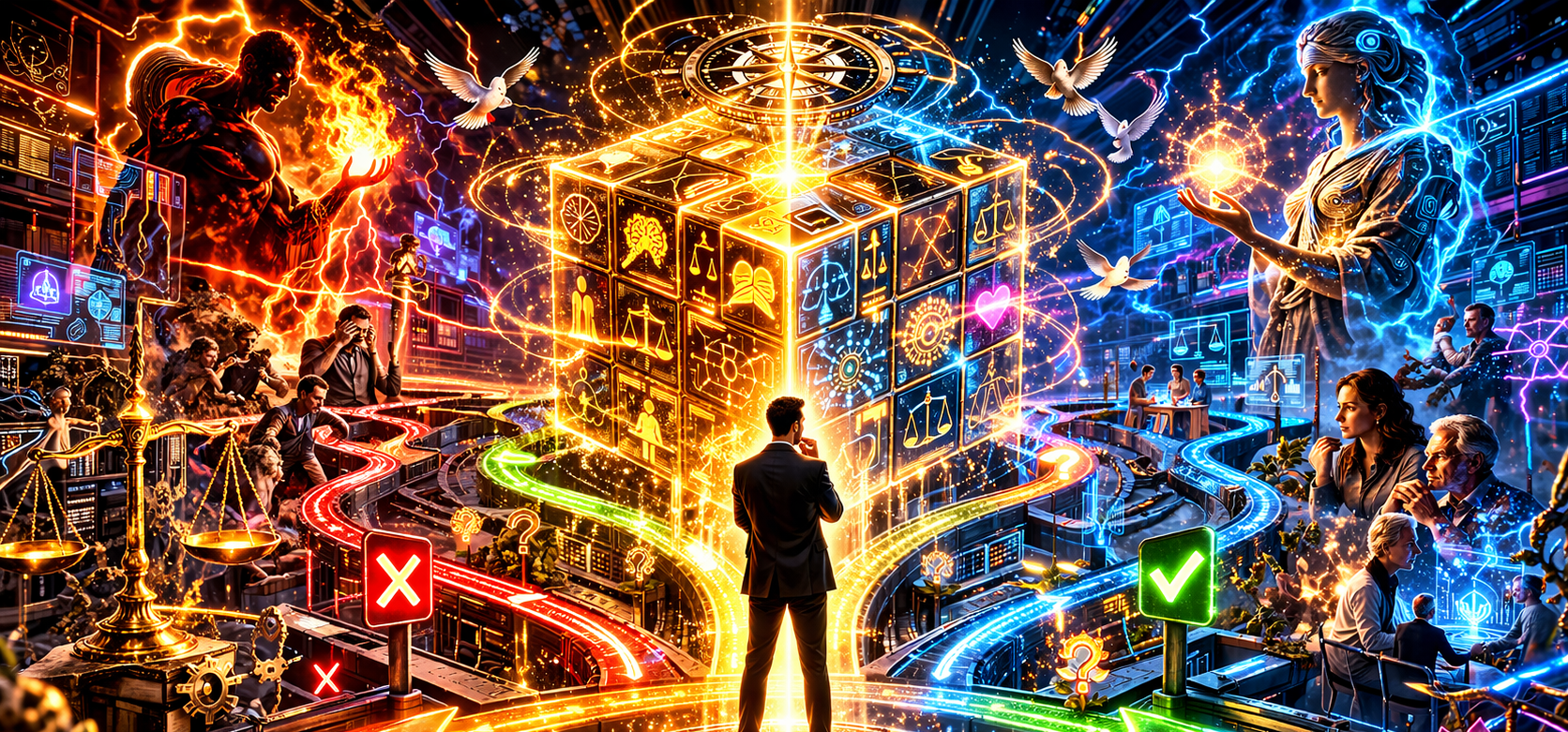
The Decision Logic is the transition from “Feeling” to “Calculating.” It is the implementation of a rigorous, clinical protocol for processing ethical choices. To use this logic is to treat every dilemma not as an emotional burden, but as a technical problem to be solved through a series of logical gates. By standardizing the way you process choices, you eliminate the “Cognitive Drag” of doubt and replace it with a high-velocity execution model. You don’t “agonize” over a choice; you run the protocol, identify the optimized path, and execute with total intent.
The Failure of the “Gut Check”
The traditional “Gut Check” is a relic of our evolutionary past, designed for tribal survival, not modern sovereignty. In a professional context, relying on your “gut” leads to three systemic failures:
- The Threshold of Exhaustion: Your moral intuition is tethered to your glucose levels and your sleep cycles. A “Correct” decision in the morning becomes an “Expedient” decision at 2:00 AM.
- The Mimetic Ghost: Much of what we perceive as “Gut Feeling” is actually the internalized voice of the collective. It is the subconscious fear of social ostracization or the desire for unearned approval. It is a signal from the crowd, not your own architecture.
- The Complexity Ceiling: Intuition is binary. It likes “Good vs. Bad.” It is incapable of processing a “Five-Variable Trade-off” where every option involves a significant loss.
The Decision Logic replaces this erratic biological signal with an Analytical Architecture.
Protocol I: The Pre-Execution Filters
Before a dilemma is allowed to enter the logic engine, it must pass through the Pre-Execution Filters. This prevents the “Drain” of metabolic energy on irrelevant or non-sovereign problems.
- The Jurisdiction Check: Is this problem within your “Sovereign Perimeter”? Do you have the agency to impact the outcome, and are you the primary stakeholder? If not, you do not “process” the ethics; you delegate the decision or ignore the noise. You do not spend your integrity on situations where you have no authority.
- The Bedrock Violation Scan: Does the proposed action violate a “Non-Negotiable Axiom” from your Moral Operating System? If the answer is “Yes,” the decision is already made. The path is aborted. There is no negotiation with foundations.
- The Information Fidelity Audit: Do you have “High-Resolution Data,” or are you operating on “Market Noise” and “Emotional Narrative”? If the data is low-fidelity, the logic engine cannot run. Your first ethical choice is to pause and acquire the raw truth.
Protocol II: The Logic Gates (The Evaluation Matrix)
Once a dilemma passes the filters, it enters the Logic Gates. This is the core of the operational guide. You process the variables through three distinct “Gates” to identify the optimized maneuver.
Gate A: The Symmetrical Reciprocity Gate
You analyze the maneuver through the lens of Systemic Sustainability. * The Question: “If every sovereign operator in my network used this exact logic, would the network flourish or collapse?”
- The Goal: To avoid “Predatory Logic” that destroys the very environment you intend to dominate. You seek maneuvers that are “Infinite Game Compatible.”
Gate B: The Trajectory Gate
You move from “Immediate Outcome” to “Long-Term Vector.”
- The Question: “Does this choice move me closer to my ten-year mission, or does it trade long-term sovereignty for short-term comfort?”
- The Goal: To identify “High-Interest Ethical Debt.” If a choice makes your life easier today but compromises your brand or your architecture tomorrow, the gate remains closed.
Gate C: The Autonomy Gate
You evaluate the Impact on Future Agency.
- The Question: “Does this choice increase my future options, or does it lock me into a path of institutional dependency?”
- The Goal: To ensure that every ethical choice is an investment in your own freedom. You avoid “Compromise Traps” that require a permanent surrender of your “Walk-Away Power.”
Protocol III: The Risk-Weighted Execution
After passing through the gates, the Decision Logic identifies the Optimized Maneuver. However, in the “Gray Zone,” the optimized maneuver often carries a cost. You do not ignore this cost; you Weight and Mitigate it.
- Calculating the “Integrity Tax”: If the optimized path involves a loss of short-term capital or social standing, you calculate that as a “Tax” required to maintain your architecture. You pay the tax willingly, recognizing it as an investment in your long-term “Market Value.”
- The Secondary-Effect Buffer: You identify the potential “Negative Spillover” of your decision. Who will be impacted? What is the “Reputational Risk”? You build a “Buffer” into your execution plan to manage these secondary variables without compromising the primary choice.
- The Radical Responsibility Anchor: Once the path is chosen, you assume 100% ownership of the outcome. You do not blame “The Situation” or “The Market” for the hard choices you made. You anchor the decision in your own sovereign intent.
Protocol IV: The Post-Execution Audit (The Feedback Loop)
The Decision Logic is a Self-Correcting System. After every major choice, you perform an “After-Action Review” to refine the engine.
- The Deviation Scan: Did the actual outcome match the simulation? If not, where did the logic fail? Was it a data error or a gate-weighting error?
- The Signal-to-Noise Review: Did you allow “Emotional Static” to influence the logic? Identify the moments where you felt the “Mimetic Ghost” pulling at your needle.
- The Architecture Patch: Based on the results, do you need to “Harden” a driver or “Update” a security protocol in your Moral OS? Every ethical choice is a data point for future mastery.
The Sovereign Result: The Velocity of Certainty
Why is the Decision Logic the ultimate edge for the elite operator? Because Certainty is a Force Multiplier.
While your competitors are stuck in “Paralysis by Analysis”—agonizing over feelings and social consequences—you are moving. Because you have a “Protocol,” you don’t experience “Decision Fatigue.” You can process a hundred complex dilemmas with the same resolution and speed as a single one.
This velocity creates its own Market Gravity. People gravitate toward the person who knows exactly why they are doing what they are doing. Your decisions are not “guesses”; they are the outputs of a hardened, high-fidelity system. You become the most “Predictable” and “Reliable” entity in the room, even when your choices are unconventional or difficult.
Conclusion: The Mandate of the Operator
Stop asking your “Gut” for permission. Stop waiting for the “Right Feeling” to arrive. The market doesn’t care about your feelings; it cares about your Execution.
The Decision Logic is your technical manual for the Gray Zone. It is the commitment to processing the world through the lens of first principles rather than fleeting impulses. Build the filters. Harden the gates. Run the engine. When you master the logic of choice, you stop being a victim of your circumstances and start being the engineer of your own destiny.
Filter the dross. Run the gates. Execute the logic.










Leave a Reply