

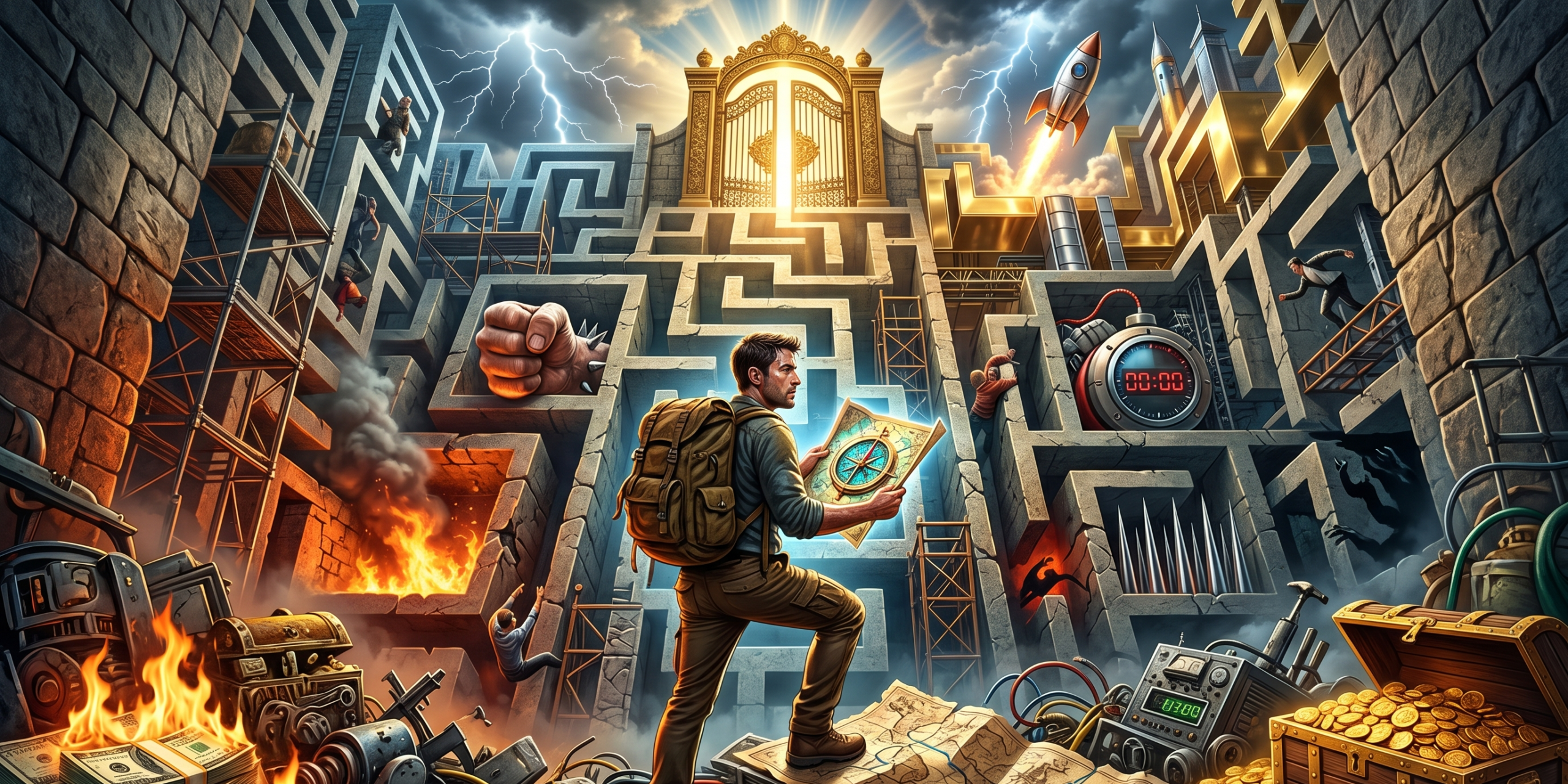
The primary distinction between a manager and a visionary leader lies in the length of their decisional horizon. While management is largely concerned with the optimization of the present—ensuring that current systems run at peak efficiency—visionary leadership is a technical discipline focused on “Future-Back” planning. This involves making choices today that may appear suboptimal or even counter-intuitive in the short term, but which are essential for securing a dominant position in a market that does not yet exist.
The Temporal Displacement of Choice
Visionary leadership requires a high degree of “Temporal Displacement.” This is the ability to mentally inhabit a future state (five, ten, or twenty years out) and work backward to the present. Most business decisions are “Present-Forward,” meaning they take current resources and current trends and attempt to project them slightly ahead. This approach is safe, but it is rarely transformative.
In contrast, a visionary decision starts with a “Desired Future State.” For example, a leader in 2026 might look at the trajectory of decentralized energy and decide to pivot their entire logistics firm toward an autonomous, solar-powered fleet. In the short term, the capital expenditure is astronomical and the infrastructure is non-existent. However, the decision is made because the leader understands that in ten years, the cost of carbon-based logistics will be prohibitive. The “Future-Back” logic makes the decision rational, even when the “Present-Forward” data suggests it is a risk.
The Mechanism of Future-Back Planning
To implement this style of leadership, organizations must adopt a specific methodology for evaluating choices. This is not about “guessing” the future; it is about analyzing deep-tech trajectories, demographic shifts, and resource scarcity to identify Inherent Inevitabilities.
- Step 1: Identify the Inevitabilities. What are the things that must be true in ten years? (e.g., The increase in AI-driven labor, the scarcity of fresh water, or the total digitization of currency).
- Step 2: Define the Disruption. If these things are true, which current business models will become obsolete?
- Step 3: Asset Reallocation. What assets do we possess today that can be repurposed to serve that future reality?
- Step 4: The “Bridge” Decisions. What are the incremental choices we must make today to ensure we have the “Ticket to Play” when that future arrives?
This framework prevents a vision from becoming a “hallucination.” It anchors the future in the hard reality of current resource management.
The Visionary’s Burden: Managing Stakeholder Dissonance One of the most difficult aspects of visionary leadership is the social and political friction it creates. Stakeholders, particularly those focused on quarterly returns, will naturally resist decisions that sacrifice immediate margins for future positioning. A visionary leader must be a master of “Cognitive Reframing,” helping their team and investors see that the “safe” path of doing nothing is actually the highest-risk option due to the certainty of future obsolescence.
Distinguishing Vision from Delusion
Not every “big idea” is a visionary decision. There is a technical threshold that separates a strategic bet from a reckless gamble. This threshold is defined by Signal Fidelity.
A visionary leader looks for “Weak Signals”—early indicators of a major shift that are currently being ignored by the mass market. The ability to distinguish a weak signal from mere noise is the core skill of the innovative brain. For example, the early adoption of blockchain was a weak signal of the move toward decentralized trust. Many saw it as noise; visionaries saw it as the foundation of a new financial layer.
To avoid the “Visionary Trap,” leaders must utilize a Validation Protocol:
- Technical Feasibility: Does the physics of the idea work? If the vision relies on technology that violates known laws of science, it is a delusion.
- Economic Viability: Is there a path to a sustainable margin? A vision that requires permanent subsidies is not a business; it is a hobby.
- Adoption Velocity: Is there a clear reason for a human being to change their behavior to use this new future? If the friction of adoption is too high, the vision will fail regardless of how “correct” the technology is.
Operationalizing the Long-Shot
Once a visionary decision is made, the leader must protect it from the “Immune System” of the organization. Most companies are designed to kill novelty because novelty is inefficient. To protect the future, visionary leaders often create “Skunkworks” or isolated R&D units that operate under a different set of rules and KPIs than the core business.
In these units, the metric is not ROI, but Learning Velocity. How fast are we identifying what doesn’t work? How quickly are we iterating the prototype? By decoupling the visionary project from the quarterly pressures of the main organization, the leader ensures that the “Seed of the Future” has enough time to take root.
The Psychology of High-Stakes Choice
Visionary decisions require a specific psychological profile: High Ambiguity Tolerance. Most people find uncertainty physically and mentally draining. They want clear answers and immediate feedback. A visionary leader, however, must be comfortable living in the “Gray Space” for years, making decisions where the results won’t be known for a decade.
This requires a shift in how a leader views “Failure.” In a visionary context, a failed experiment is a “Data Acquisition Event.” It is a necessary expense in the process of mapping the future. Leaders who cannot handle the social stigma of a visible failure will eventually default to safe, “Present-Forward” choices that lead to stagnation.
The Legacy of the Future
Ultimately, visionary leadership is about the creation of Legacy. A legacy is not what you leave behind; it is what you put in motion. The decisions that shape the future of business are those that address the needs of the next generation of consumers, employees, and citizens.
When a leader makes a visionary choice, they are effectively placing a bet on their own ability to understand the trajectory of the human race. It is the highest form of entrepreneurial agency. It transforms the business from a reactive entity into a “Market Maker”—an organization that doesn’t just respond to the world, but actively constructs the world it wants to inhabit.
Practical Checklist for Visionary Execution
- Audit your time: Are you spending at least 20% of your week thinking about the world five years from now?
- Challenge your “Cash Cows”: If your most profitable product were to disappear tomorrow, what would replace it?
- Seek Dissent: Are you surrounding yourself with people who challenge your assumptions about the future?
- Invest in “Option Value”: Are you making small bets on multiple emerging technologies to ensure you have a “way in” when they mature?
Prosperity in the future is not a matter of luck; it is a matter of current decisional integrity. By mastering the art of the visionary choice, leaders can move beyond the limitations of the present and build organizations that are truly “Future-Proof.” Success belongs to those who see the inevitable coming and decide to meet it halfway.










Leave a Reply